
Why Q1 Is the Best Time for Medicare Agents to Host a Webinar
Most Medicare agents cross the December 7 finish line and exhale. The phones slow down. The urgency fades. January feels like a chance to recover.
That mindset is costing you business.
January is actually the highest-attendance webinar month of the year — across all industries, all audiences, all formats. Your competitors have gone quiet, your clients’ calendars are clear, and the questions that were built up during AEP still need answers. Your clients have just watched their plans change. Their questions didn’t stop on December 8. They just don’t know where to go next.
A well-planned Q1 webinar puts you in the room when your competitors have gone quiet. It strengthens relationships with existing clients. It reaches prospects who weren’t ready in October. And it positions you as the expert they call first when AEP 2027 rolls around.
The catch? A great Q1 webinar requires a Q4 plan. You need time to schedule, build your campaign, and market it properly. That window is right now.
The Post-AEP Silence Is an Opportunity in Disguise
Think about what your clients just went through. They received their Annual Notice of Change in the fall, watched their premiums shift, their benefits adjust, or their plan exit the market entirely. Some made changes during AEP. Many didn’t — or aren’t sure they made the right call.
Then December 8 arrives, and most agents disappear until spring.
Your clients still have questions. They’re just not sure who to ask. A Q1 webinar answers that question before they go looking somewhere else.
This isn’t just a retention play, either. Referrals are a natural byproduct of a trusted relationship. Clients who hear from you in January — with helpful, relevant information — are far more likely to mention your name to a friend who is also confused about their coverage.
MA OEP Is a Second Enrollment Window. Are You Using It?
The Medicare Advantage Open Enrollment Period runs January 1 through March 31 every year. During this window, beneficiaries already enrolled in a Medicare Advantage plan can switch to a different MA plan or return to Original Medicare with a standalone Part D plan.
Most beneficiaries don’t know this window exists. Many agents underestimate it too.
Here’s why it matters in 2027 specifically: the 2026 AEP was one of the most disruptive enrollment seasons in recent memory. Premiums rose, plans exited markets, and benefits were reduced. The national median out-of-pocket maximum jumped nearly 10% in a single year. Some clients made the best choice available to them in October. Others are already having second thoughts.
MA OEP is their chance to make a change. Your Q1 webinar is how they find out that chance exists — and how you become the agent who helps them use it.
Why January Webinar Attendance Is So High
The data is consistent across multiple industry reports. January dominates the webinar calendar, driven by fresh-start energy, clear calendars, and new-year momentum. It outperforms every other month, including the peak of AEP season. February holds strong as well, keeping Q1 engagement well above summer and mid-year averages. That gives you a two-month runway of elevated attention before spring distractions set in.
For Medicare agents, the timing aligns with something even more specific than general New Year momentum. Your audience just lived through a major coverage decision. They have questions they didn’t get answered in October. Their calendars aren’t yet full with spring commitments. They’re at home, they’re online, and they’re receptive.
The competitive environment in Q1 is also worth noting. Most agents and organizations concentrate their webinar budgets in the fall. Q1 is comparatively quiet. Your invitation doesn’t have to compete with five other Medicare events in the same month. You have more of the audience’s attention with less effort to earn it.
What a Q1 Medicare Webinar Should Cover
Your Q1 webinar isn’t a second AEP presentation. The enrollment window has closed. Clients don’t need another walk-through of every plan on the market. They need clarity on what changed, what options they have right now, and who to call with questions.
Strong Q1 webinar topic angles include:
- What Changed About Your Medicare Coverage in 2027 — and What You Can Do About It
Address the plan changes, benefit adjustments, and cost increases that beneficiaries experienced during AEP 2026. Help them understand what their new coverage actually includes, what it doesn’t, and when they can make changes during MA OEP.
- The Medicare Window Most People Miss: What You Can Still Change Before April
Focus entirely on MA OEP. Most beneficiaries have no idea this window exists. Positioning yourself as the agent who told them about it — and helped them use it — is a powerful trust-builder heading into 2027.
- Your Medicare Questions Answered: A Free Live Q&A for [Your City/Region]
An open Q&A format works especially well in Q1. Clients come with specific, current questions. Answering them live, on camera, builds the kind of credibility no brochure can replicate.
- Turning 65 in 2027? Here’s Everything You Need to Know Before You Enroll
The T65 audience is active year-round — and Q1 is when many people who turn 65 later in the year start their research. A webinar targeted at this segment generates pipeline that pays off throughout the year.
Keep your topic focused. One clear subject, covered thoroughly, outperforms a wide-ranging overview every time.

How to Market Your Q1 Webinar Effectively
A great webinar with poor promotion is just a conversation you had by yourself. Marketing your Q1 event requires the same multichannel thinking that drives results during AEP. It just needs to start earlier than most agents expect.
Direct mail anchors the sequence. Send your invitation to a targeted list of Medicare-eligible prospects in your area four to six weeks before the event. Direct mail builds credibility and creates initial awareness that digital channels reinforce.
Email drives registrations. Email drives registrations. According to 2026 benchmarks, more than 63% of webinar sign-ups trace back to email — making it the single highest-converting promotional channel for events. Send at least three touches: an early-bird announcement, a formal invitation, and a last-chance reminder. Non-responders should receive different messaging than registered attendees.
Social ads extend your reach. Facebook and Instagram targeting let you reach Medicare-eligible adults in your area by age, location, and interest. Target family members alongside the primary audience. Keep your ad copy focused on the problem your webinar solves, not the event format itself.
Retargeting recovers lost registrations. Anyone who visits your webinar landing page but doesn’t sign up should see a follow-up ad as they keep browsing. This is one of the most cost-effective ways to convert warm interest into confirmed seats.
Timing matters on the day itself. Midweek webinars consistently see better turnout — Tuesdays, Wednesdays, and Thursdays all outperform Monday and Friday. Late-morning and early-afternoon slots, specifically 11 AM and 2 PM, tend to attract the most attendees. For a Medicare audience, avoid early mornings and Friday afternoons entirely.
CMS Compliance for Q1 Webinars
New CMS marketing rules took effect October 1, 2026, and apply to all AEP 2027 marketing. Those rules extend to your Q1 event promotion as well.
Know your event type. An educational webinar — where you discuss Medicare topics generally without naming specific plan benefits — operates under different rules than a sales event. As soon as you discuss plan-specific benefits, your event is classified as a sales event, regardless of how you promoted it. Under the new 2027 rules, you can hold educational and sales events in the same session, provided attendees are notified of the transition and given a meaningful opportunity to exit before the sales portion begins.
The SOA rule has changed. The 48-hour waiting period between Scope of Appointment completion and a personal marketing appointment has been eliminated. You can now collect SOA forms during your webinar. The SOA is still required before any enrollment conversation — you just no longer have to wait 48 hours once you have it.
Digital promotion must be CMS-compliant. Any webinar promotional content that mentions a specific plan by name, highlights specific benefits, or includes enrollment information must be filed through HPMS before use. Keep your general educational promotions clearly general.
Record your webinar. Call recording and documentation requirements remain in effect. Retain records consistent with current CMS guidelines and your carrier agreements.
When in doubt, consult your upline, your FMO, or your compliance resource before publishing marketing materials.
Don’t Forget On-Demand: Your Webinar Keeps Working After It Ends
One of the most overlooked advantages of webinars is what happens after the live event. Research shows that roughly 86% of attendees watch live — but 24% watch only the replay. That means your audience keeps growing after the event ends.
Recording your Q1 webinar and making it available on demand significantly extends its value. A link shared in a follow-up email, posted to your website, or sent to a client who couldn’t attend live turns a one-time event into a lead generation asset that runs through spring.
An on-demand recording also serves as content for social media, a resource for new referrals, and a credibility signal for prospects who find you through search. You spent the time building the webinar — let it keep working.
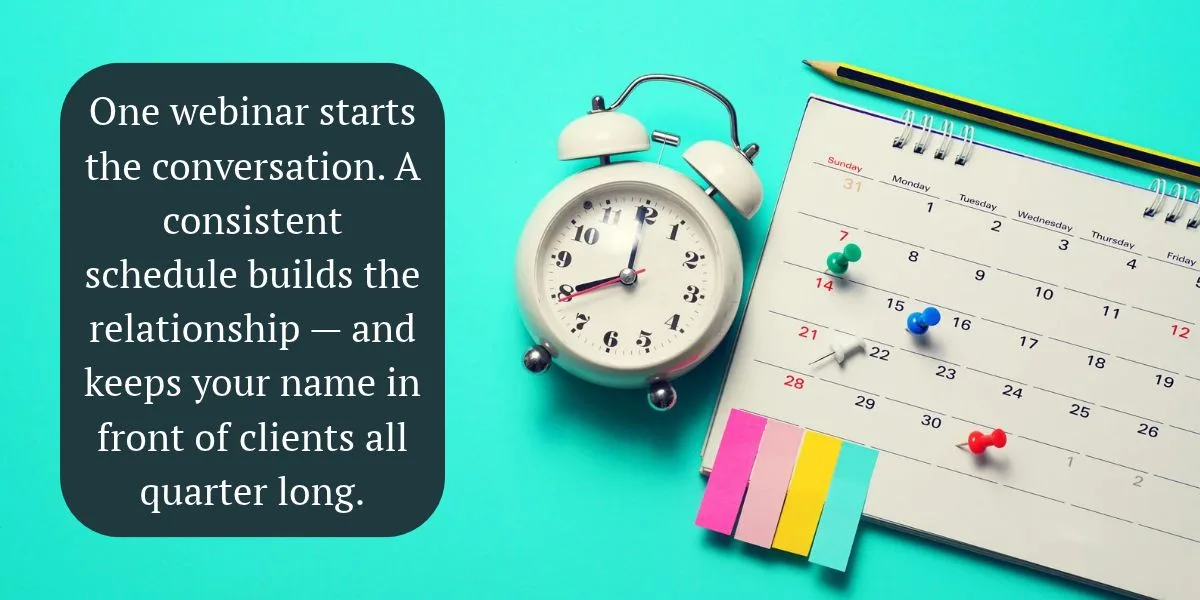
Why Planning in Q4 Is the Difference-Maker
Here’s the reality: a rushed Q1 webinar is worse than no webinar at all. A poorly promoted event, a compliance-risky registration page, or a last-minute topic with no clear audience tells attendees you don’t take their time seriously.
The agents who run standout Q1 webinars start building in Q4. That means:
- Choosing your topic and locking your date before the holidays create scheduling chaos
- Building and reviewing your promotional materials, including mailers, emails, social ads, and landing page, so they’re ready to deploy in early January
- Getting your direct mail into production early enough to land before competing January mail clutters the box
- Confirming your technology setup, including platform, registration link, recording capability, follow-up sequence, so nothing breaks on the day
Six weeks of lead time is the minimum for a well-marketed webinar. Eight weeks is better. That means a January event needs its plan finalized in November. A February event gives you slightly more runway, but not as much as most agents assume.
Ready to Build Your Q1 Webinar Campaign?
Your Q1 webinar should do more than fill a time slot. It should fill your pipeline. A well-executed campaign — direct mail, social ads, email, and a strong follow-up sequence — turns a single event into months of new conversations. The agents who run that kind of campaign don’t stumble into a busy Q1. They build one.
Final Thoughts
Q1 is not the slow season. It’s the season most agents treat as slow — and that’s exactly what makes it valuable.
Your clients have questions. Your prospects are online and paying attention. January delivers the highest webinar attendance rates of the entire year, and your competition is quiet. The infrastructure to reach that audience is the same system you built for AEP. Applying it in Q1 takes planning, not a bigger budget.
The time to build that plan is now. Agents who lock in their Q1 strategy before the holidays will start 2027 ahead. Everyone else will spend January catching up.
Frequently Asked Questions
Why is Q1 a good time for Medicare agents to host a webinar?
January consistently has the highest webinar attendance of any month, and the competitive landscape is far less crowded than during AEP. Beneficiaries also enter Q1 with fresh questions about plans that changed during AEP. Hosting a webinar in January or February positions you as a trusted resource when clients are most receptive.
What is the Medicare Advantage Open Enrollment Period, and how does it relate to Q1 webinars?
The MA OEP runs January 1 through March 31. During this window, beneficiaries already enrolled in a Medicare Advantage plan can switch to a different MA plan or return to Original Medicare. Most beneficiaries don’t know this option exists. A Q1 webinar that educates clients about MA OEP is one of the most effective ways to add value, retain business, and generate referrals early in the year.
What should a Q1 Medicare webinar cover?
The strongest Q1 topics are specific and timely. Good options include a plain-language review of what changed during AEP 2026, an overview of what beneficiaries can still change during MA OEP, a live Q&A for existing clients, or a dedicated session for people turning 65 in 2027. Avoid trying to cover everything — one focused topic, done well, outperforms a broad overview every time.
How far in advance should I start marketing a Q1 webinar?
At minimum, six weeks before your event date. Eight weeks is better. For a January event, lock your planning and promotional materials by mid-November. Direct mail needs to be in production before the holidays to ensure timely delivery.
Do the new CMS rules affect how I can promote a Q1 webinar?
Yes. CMS marketing rules effective October 1, 2026, apply to your Q1 event promotion. Any digital advertising content mentioning a specific plan by name or highlighting plan-specific benefits must be filed through HPMS before use. Educational event promotion that stays general is held to different standards than plan-specific marketing. Confirm your materials with your compliance resource before publishing.
Can I collect SOA forms during my Q1 webinar?
Yes, under the 2027 CMS rules. The 48-hour waiting period between SOA completion and a personal marketing appointment has been eliminated. You can now collect SOA forms at educational events. The SOA is still required before any enrollment conversation — but you no longer need to schedule a separate follow-up appointment just to meet the 48-hour window.
What should I do with the webinar recording after the event?
Make it available on demand. Share the replay link in your follow-up email sequence, post it to your website, and send it to anyone who registered but couldn’t attend live. According to Univid’s 2026 Webinar Insights report, 24% of your total audience watches only the replay — meaning your reach grows well beyond the day of the event. A recorded webinar also serves as a long-term content asset for referrals, social media, and SEO.