
The Opportunity Most Estate Planning Attorneys Are Missing
Right now, millions of Americans believe they have handled their estate planning. A questionnaire was answered, a PDF was downloaded, and somewhere between $99 and $600 changed hands. The document is filed away. Everyone has been reassured. The mental checkbox has been ticked. Plan done.
They are wrong. And most of them will not find out until it is too late to fix it.
According to Trust & Will’s 2026 Estate Planning Report, 56% of U.S. adults have no estate planning documents whatsoever. But here is the number that does not make the headlines: a significant and growing portion have documents that are inadequate, unfunded, outdated, or legally flawed. They just do not know it yet.
For estate planning and elder law attorneys, this is not a threat. It is a pipeline.
The rise of DIY estate planning platforms has done something no attorney marketing campaign could have accomplished on its own. It has made estate planning a mainstream consumer behavior. Millions of Americans who previously would have done nothing are now actively thinking about wills, trusts, and powers of attorney. They are searching online, attending webinars, and talking to their financial advisors about next steps. The awareness is there. The motivation is there. They are primed.
The question is not whether there is demand. The question is whether your practice is positioned to capture it.
Understanding the DIY Landscape — And Its Limits
Before you can market effectively against this trend, you need to understand exactly what the online platforms do, what they cannot do, and where they consistently fall short. That is where your value proposition lives.
What Online Services Sell
Platforms like LegalZoom, Trust & Will, Rocket Lawyer, and Nolo sell document templates. A consumer answers a standardized questionnaire, the platform generates a document, and the consumer downloads it. The process is fast, inexpensive, and accessible. And it serves a genuine purpose for people with genuinely simple estates and straightforward family situations.
The critical limitation is baked into their own disclaimers. LegalZoom’s website states plainly: “LegalZoom is not permitted to engage in the practice of law.” They generate documents. They do not provide legal advice, evaluate whether those documents are appropriate for the client’s specific situation, or ensure the plan is properly executed and funded.
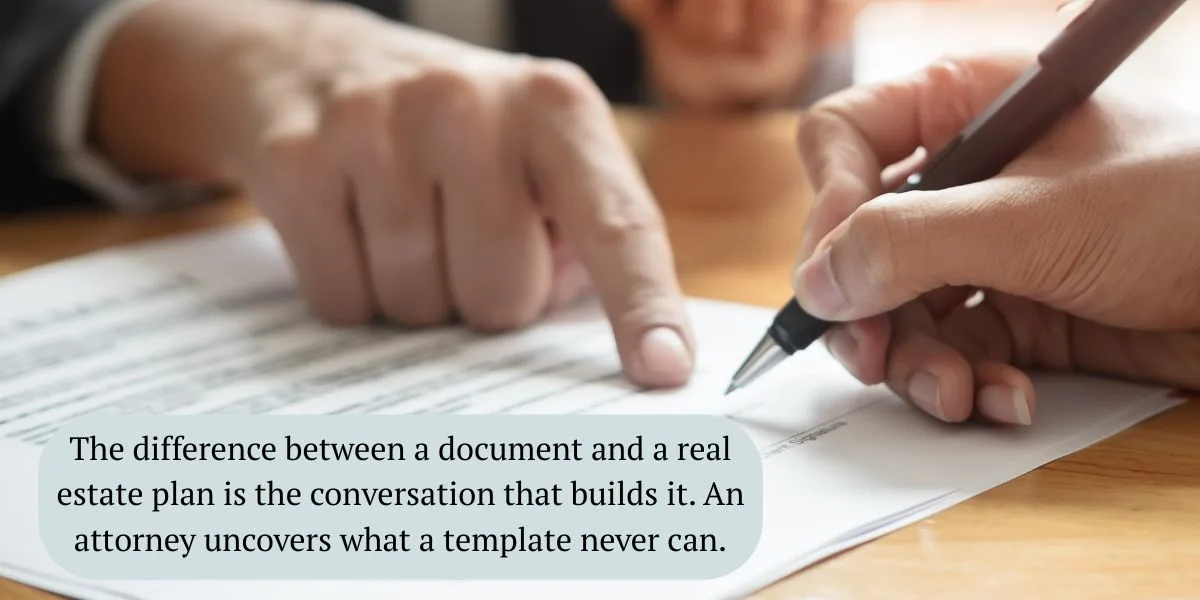
That gap between a document and a functioning estate plan is where the damage happens — and where your opportunity lives.
The Unfunded Trust Problem
The most expensive mistake in DIY estate planning is not a drafting error. It is an execution failure. A revocable living trust only works if the assets it is meant to protect are actually transferred into it — a process called funding. The trust document itself does nothing until that step is complete. Most consumers who purchase a DIY trust never complete it, either because they were not clearly instructed to do so or because they did not understand what it required.
An unfunded trust does not avoid probate. It does not protect the family. It is, in plainest terms, a stack of papers with false authority. Probate in 2026 typically takes between 9 and 18 months to resolve and costs between 3% and 8% of the estate’s gross value. On a $500,000 estate, that means $15,000 to $40,000 in costs. Plus, over a year of legal delay for the family, even though the original intent was to avoid exactly that.
Every estate planning attorney has seen this scenario. The family thought they were protected. They were not.
The Template Problem
Standardized forms cannot account for the complexity of modern American families. Blended families with children from prior relationships. Disabled family members who receive government benefits. Business owners who need succession planning woven into their personal estate plan. Clients with real estate in multiple states. Families staring down the Medicaid five-year look-back window. None of these situations are adequately served by a questionnaire. The platform has no mechanism to flag what it does not know to ask.
Consumers may never realize a DIY program misinterpreted their state’s law or that they entered information in error. Instead, a loved one discovers the errors upon the death of the consumer or when a will is being contested.
By then, the opportunity to correct the mistake is gone. The family pays to fix it in probate. And often, they end up in your office anyway, under the worst possible circumstances, with the worst possible outcome already locked in.
The Elder Law Gap
This is perhaps the most significant gap in the DIY landscape, and the one with the highest stakes for your clients. No online estate planning platform addresses Medicaid planning, long-term care strategy, or asset protection for clients facing the prospect of nursing home care. These are not add-on services. For a large and growing portion of the 55-and-older population, they are the most financially critical part of any estate plan.
Proactive elder law planning typically costs $6,500 to $9,500 and can protect hundreds of thousands of dollars in assets. Crisis elder law planning, initiated after a care need has already emerged, typically costs $12,000 to $20,000 or more, with dramatically fewer options available.
Every week that a client delays a conversation about Medicaid planning is a week closer to the five-year look-back window closing on their best options. This urgency is real, and it is something you can communicate clearly and credibly in your marketing.

Who Is in Your Pipeline Right Now — Whether You Know It or Not
Understanding your market means understanding who is already searching for what you offer, even if they do not know they need an attorney yet. There are several distinct prospect profiles that represent your highest-value client acquisition opportunities in 2026.
The False Sense of Security Client
This person completed an online will or trust one to five years ago and has not thought about it since. Their familyand their assets have changed. Buit their documents have not. They are not actively searching for help because they believe they are covered. Reaching them requires marketing that surfaces the specific gaps in DIY planning. Specifically, content that speaks to what they do not know they are missing. This is the largest and most underserved segment in the market right now.
The Recently Triggered Client
Estate planning decisions are almost always triggered by a life event. A diagnosis, parent’s death, major inheritance, new child, divorce, a retirement date approaching. Medical diagnoses, retirement, and the death of a loved one are consistently the top triggers that motivate Americans to finally create or update their estate plan. Reaching these clients requires being visible at the moment of that trigger. This can be done through search advertising, targeted social media, and referral relationships with financial advisors, healthcare providers, and other professionals who interact with families at these inflection points.
The Medicaid Planning Client
Adults in their late 50s through 70s who own meaningful assets and are beginning to think seriously about long-term care represent one of the highest-value client segments in estate planning and elder law. The combination of urgency — the Medicaid look-back clock is always running — and the complexity of the planning involved means these clients have strong motivation to hire an attorney and significant legal fees to pay. They are also the least likely to be served adequately by any online platform.
The Business Owner
Business owners who have not coordinated their personal estate plan with their business succession strategy are exposed in ways they often do not fully appreciate. Buy-sell agreements, entity structure, key-person considerations, and the tax implications of business transfers at death are all areas where an estate planning attorney provides value that has nothing to do with a template. These clients frequently arrive through referrals from CPAs and financial advisors, making those referral relationships a high-value business development priority.
The Younger Adult Who Did It Online
Will ownership among Americans actually fell five points in a single year, dropping from 31% in 2025 to 26% in 2026, even as online tools became more accessible. The people who do have documents skew younger and are more likely to have used an online service. As these clients age, accumulate assets, start families, and face more complex life situations, they will outgrow their DIY documents. Building relationships with them now, through educational content, seminars, and community presence, positions your firm as the natural choice when they are ready for a real plan.
Know Exactly Who You're Marketing To Before You Spend a Dollar
The most expensive marketing mistake estate planning attorneys make is broadcasting to everyone and converting no one. This free worksheet helps you define your ideal client profile in under 30 minutes, so every campaign you run speaks directly to the people most likely to hire you.
Marketing Strategies That Win This Audience
Knowing your opportunity is one thing. Building a marketing system that consistently converts it into consultations is another. Here is how estate planning and elder law attorneys are winning this market in 2026.
Lead With Education, Not Credentials
The prospects most likely to hire you are the ones who understand why they need you. That means your marketing cannot lead with your credentials, your years of experience, or your firm’s history. It needs to lead with information that is immediately useful to the reader, and that reveals — through education rather than sales pressure — why their current situation requires professional guidance.
Content that performs well for estate planning attorney marketing in 2026 addresses the questions prospects are already searching for. Does a will protect my home from probate? How is a trust different, and which one do I actually need? When should Medicaid planning start? These are the questions your ideal clients are typing into search engines right now — and the attorneys whose content answers them clearly and credibly are the ones earning the consultation call.
When your firm’s content answers these questions clearly and credibly, you build authority before a prospect ever contacts you. By the time they call, they are already predisposed to trust you. That shortens your sales cycle and improves your close rate on consultations.
Live Events Still Convert at the Highest Rate
For estate planning and elder law attorneys, in-person seminars and educational workshops consistently produce the highest-quality leads of any marketing channel. The reason is structural: trust is the foundation of the attorney-client relationship in estate planning, and nothing builds trust faster than a room where prospects can see you, hear you answer questions in real time, and experience your expertise firsthand.
Attendees who meet you at a live event before their consultation are not cold leads evaluating competing options. They are warm prospects who have already decided you are credible. They come to the consultation ready to retain. That difference in lead quality translates directly into higher conversion rates and higher average case values.
The format that works best in 2026 combines in-person events with a hybrid option for prospects who prefer to attend virtually. This combination that maximizes both attendance and geographic reach without a proportional increase in cost or effort. Topics that draw strong attendance include avoiding probate, protecting assets from long-term care costs, what happens to your estate if you become incapacitated, and — for the right audience — the implications of current tax law for families with meaningful assets.
The key operational factor is consistent scheduling. Firms that host events monthly or quarterly build a compounding pipeline. Each event produces some immediate conversions and a larger group of warm leads who convert over the following weeks and months. Firms that treat events as one-off campaigns get one-off results.
The Estate Planning Attorney's Complete Guide to Running Seminars That Fill Your Calendar
Seminars remain the highest-converting client acquisition tool for estate planning attorneys, but only when they’re done right. This handbook walks you through everything from venue selection and invitation strategy to presentation structure and post-event follow-up that turns attendees into retained clients.
Multichannel Targeting Makes Every Other Strategy More Effective
Estate planning prospects follow a nonlinear path to hiring an attorney. They may encounter your firm through a direct mail piece, later see a social media ad, Google your name, read your blog, and finally register for your seminar — all before they ever speak to someone at your office. A multichannel marketing strategy ensures your firm is present and consistent across each of those touchpoints.
The goal is not to be on every channel simultaneously. The goal is to be consistently present on the channels where your ideal clients are already looking, and to deliver a unified message across all of them so that your firm feels familiar and credible by the time a prospect reaches out.
Referral Relationships with Financial Advisors and Healthcare Professionals
The professionals who interact with your ideal clients at the moment of a planning trigger are among the most valuable business development relationships you can build. Financial advisors, CPAs, primary care physicians, geriatric care managers, and assisted living operators all regularly encounter families who need estate planning and elder law services. And most of them welcome a trusted referral partner they can confidently recommend.
Building and maintaining these relationships requires consistent outreach, educational value exchange, and a clear articulation of how you serve the clients you share. Attorneys who position themselves as collaborative partners, rather than competitors or afterthought, consistently generate a higher volume of warm referrals from these networks.
Nurture Leads Over the Long Buying Cycle
Estate planning decisions are rarely impulsive. A prospect who attends your seminar in March, tells you they are interested, and then goes quiet is not a dead lead. They are in a decision cycle that may take several months, particularly for clients who are working through a complex family situation or a Medicaid planning scenario with significant financial implications.
A structured lead nurturing system, including monthly email newsletters, ongoing event invitations, and periodic personal follow-up for high-value prospects, keeps your firm top of mind through that entire cycle. When the prospect is finally ready to move forward, they call the attorney who stayed in touch, not the one who sent a single follow-up email in April and moved on.
The attorneys who invest in systematic nurturing consistently outperform those who rely on immediate conversions from every marketing touchpoint.
Ready to See What a Real Estate Plan Can Do for Your Practice?
Your clients deserve more than a downloaded template, and so does your pipeline. Connect with a LeadingResponse strategist to find out how our estate planning and elder law programs can bring qualified, motivated prospects directly to your firm. No pressure, no obligation. Just a straightforward conversation about what growth looks like for your practice.
Why Partnering with a Specialist Gives You a Compounding Advantage
There is a meaningful difference between running marketing campaigns and building a client acquisition system. Campaigns produce bursts of activity. Systems produce consistent, predictable pipelines that compound over time.
For estate planning and elder law attorneys who want that kind of consistency, partnering with a firm that specializes in this specific market, rather than trying to manage multichannel marketing in-house or working with a generalist agency, delivers several distinct advantages.
Specialist firms bring proprietary audience data built from years of estate planning campaigns. They know which demographics respond to which messages across which channels. They have the infrastructure to manage direct mail, digital advertising, event promotion, and lead follow-up as an integrated system rather than a collection of disconnected tactics. And they bring a measurement framework that tells you not just how many leads you are generating, but what quality those leads are and how they are converting into retained clients.
LeadingResponse has built that system specifically for estate planning and elder law attorneys. For nearly 30 years, we have worked with firms across the country to design and execute multichannel client acquisition programs that connect attorneys with motivated, qualified prospects — through targeted seminars and workshops, ongoing webinar programs, direct mail, and expert digital marketing. More than 500 firms nationwide trust us with their client acquisition, and our approach is built around one objective: filling your calendar with the right consultations.
The DIY estate planning boom is not slowing down. The gap between what online platforms sell and what families actually need is not closing. The prospect pool that represents your best opportunity has never been larger. The question is whether your marketing is built to capture it.